Data centre boom could spike power prices up to 26%


The amount of data centres being built in Australia has dramatically ramped up in recent years. Photo: Pexels
The race to build data centres in Australia could force household electricity prices up by as much as 26 per cent within a decade, a study has found.
The artificial intelligence hubs could also use as much electricity as all homes in the state of Victoria by 2030.
The Climate Council issued the warnings on Wednesday in a report into the growing tech industry that has established 162 data centres across Australia, with another 90 planned.
The bulk of the developments are planned for Sydney and Melbourne. The centres usually operate 24 hours a day, seven days a week.
The Climate Council forecast came less than a week after a NSW inquiry heard calls for a data centre coordinator, and follows Greenpeace’s request for a moratorium on approvals so standards can be developed.
Data centres are booming in Australia as technology firms such as Microsoft, Amazon, AirTrunk and NextDC strive to meet demand for AI technology.
Commercial real estate agency Knight Frank said Australia had the second-highest data centre investment in the world following the US in 2025.
The council’s report, called Clouded Future, found the centres’ electricity use had nearly doubled in Victoria over the past year and had risen 18 per cent in NSW.
If data centre growth continued without renewable energy requirements, and instead relied on gas, they could triple their energy and water use by 2030.
By 2035, the increased demand could raise wholesale power prices in NSW by up to 26 per cent and in Victoria by 23 per cent, the study found. Energy bills in South Australia and Tasmania would also be affected.
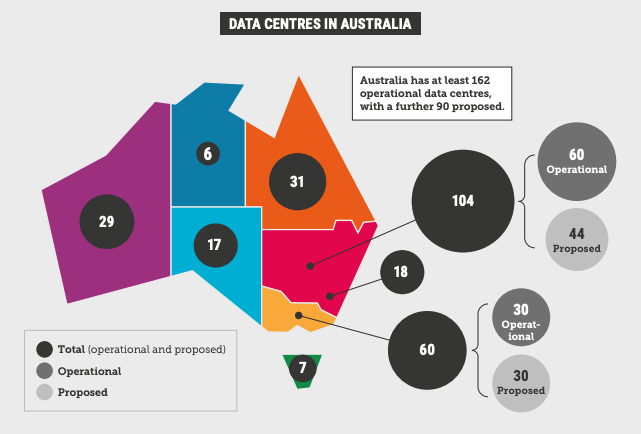
Data centres in Australian states and territories as at May 2026. Source: Climate Council
The modelling underpinning the alarming price forecast assumes rapid data centre expansion without any increase in renewable capacity, forcing greater reliance on gas and delaying coal closures.
Industry analysts said that was an extreme case, but it did highlight the system’s sensitivity to demand shocks.
Climate Council chief executive Amanda McKenzie said governments should urgently introduce strict rules for data centres to avoid such price hikes.
”Out-of-control construction of data centres would hit Australians in the hip pocket,” she said.
”Governments must proactively manage the surging demand, making sure that they are powered with clean, renewable power.”
The report issued seven recommendations for data centre rules – including 100 per cent renewable power generation within three years of operation, water efficiency standards, renewable energy backup such as batteries, and greater transparency about water and energy use.
Griffith University associate professor Joel Gilmore said some developers were already planning to use renewable energy and recycled water in projects, but all centres should be required to boost environmental standards.
”There needs to be not just voluntary action but enforceable regulations from government to ensure there is a level playing field,” Gilmore, who is the Climate Council’s energy expert, said.
Unless tech firms addressed potential energy risks now, Australia could suffer the consequences for years, Gilmore said.
”We’re seeing in other countries around the world where data centres have gone in unregulated, causing higher prices, taking significant amounts of water from the local community,” he said.
”When we’re talking about the potential scale of growth we’re seeing globally and in Australia, we want to get out in front of this now and make sure that we can plan.’
“Data centres are like a giant snowball rolling down the mountain. If they don’t bring new, low-cost renewables and storage with them and pay for the energy and water infrastructure upgrades they need, they’ll be dumping massive costs onto households and businesses.”
Industry groups representing data centre operators rejected claims they were driving fossil fuel expansion.
“Most data centre operators connect to the grid,” Data Centres Australia chief executive Belinda Dennett told The Sydney Morning Herald.
“The make-up of the grid is based on government and energy industry decisions.”
She said the sector was investing heavily in emissions reduction through long-term power purchase agreements, which she said offset about 70 per cent of centres’ electricity use and had helped bring new renewable projects online.
-with AAP
Want to see more stories from The New Daily in your Google search results?
- Click here to set The New Daily as a preferred source.
- Tick the box next to "The New Daily". That's it.