Cold war fears cool after Biden, Xi talks
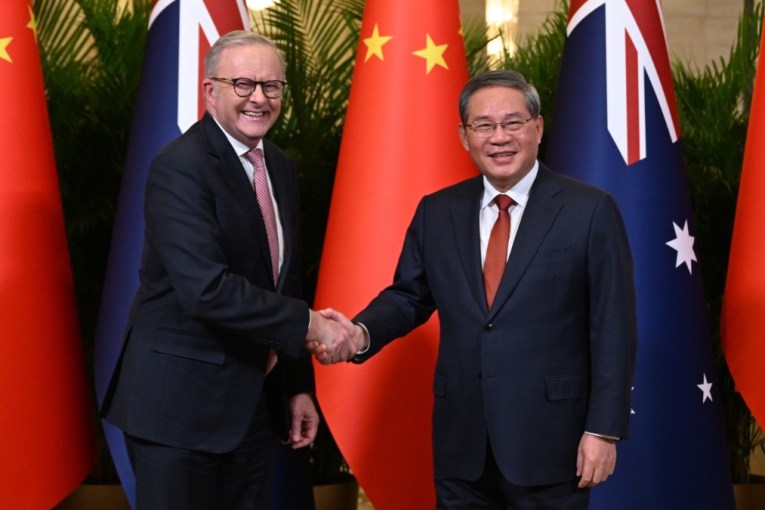
US President Joe Biden and Chinese President Xi Jinping have engaged in blunt talks over Taiwan and North Korea in a three-hour meeting aimed at preventing strained US-China ties from spilling into a new Cold War.
Amid simmering differences on human rights, Russia’s invasion of Ukraine and support of domestic industry, the two leaders pledged more frequent communications.
US Secretary of State Antony Blinken will travel to Beijing for follow-up talks.
“We’re going to compete vigorously but I’m not looking for conflict – I’m looking to manage this competition responsibly,” Mr Biden said after his talks with Mr Xi on Monday on the sidelines of the G20 summit in Indonesia.
Beijing has long said it would bring the self-governed island of Taiwan, which it views as an inalienable part of China, under its control and has not ruled out the use of force to do so.
It has frequently accused the US in recent years of encouraging Taiwan independence.
In a statement after their meeting, Mr Xi called Taiwan the “first red line” that must not be crossed in US-China relations, Chinese state media said.
Mr Biden said he sought to assure Xi US policy on Taiwan, which has for decades been to support both Beijing’s ‘One China’ stance and Taiwan’s military, had not changed.
He said there was no need for a new Cold War and he did not think China was planning a hot one.
“I do not think there’s any imminent attempt on the part of China to invade Taiwan,” he said.
On North Korea, Mr Biden said it was hard to know whether Beijing had any influence over Pyongyang’s weapons testing.
“Well, first of all, it’s difficult to say that I am certain that China can control North Korea,” he said.
Mr Biden said he told Mr Xi the US would do what it needed to do to defend itself and allies South Korea and Japan, which could be “maybe more up in the face of China” though not directed against it.
“We would have to take certain actions that would be more defensive on our behalf … to send a clear message to North Korea,” he aid.
“We are going to defend our allies, as well as American soil and American capacity.”
Mr Biden’s national security adviser Jake Sullivan said before the meeting that the President would warn Mr Xi about the possibility of enhanced US military presence in the region, something Beijing is not keen to see.
Beijing had halted a series of formal dialogue channels with Washington, including on climate change and military-to-military talks, after US House of Representatives Speaker Nancy Pelosi upset China by visiting Taiwan in August.
Mr Biden and Mr Xi agreed to allow senior officials to renew communication on climate, debt relief and other issues, the White House said after they spoke.
Mr Xi’s statement after the talks included pointed warnings about Taiwan.
“The Taiwan question is at the very core of China’s core interests, the bedrock of the political foundation of China-US relations, and the first red line that must not be crossed in China-US relations,” he was quoted as saying by Xinhua news agency.
“Resolving the Taiwan question is a matter for the Chinese and China’s internal affair,” Mr Xi said, according to state media.
Taiwan’s democratically elected government rejects Beijing’s claims of sovereignty over it.
Taiwan’s presidential office said it welcomed Mr Biden’s reaffirmation of US policy.
“This also once again fully demonstrates that the peace and stability of the Taiwan Strait is the common expectation of the international community,” it said.
-AAP