New Zealand opposition flags concerns about AUKUS

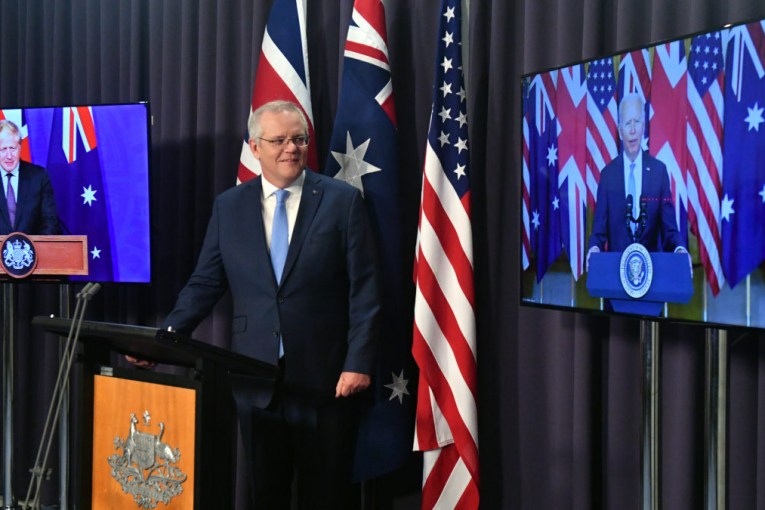
Photo: AAP
New Zealand’s opposition has flagged concerns with Australia’s AUKUS defence agreement, saying it makes New Zealand less safe, while querying whether the deal will even come to pass.
Australia is New Zealand’s sole military ally, but New Zealand is not involved with the military tie-up between Australia, the United States and United Kingdom, from which Australia will receive nuclear technology to power submarines.
Wellington, like many Pacific capitals, is firmly anti-nuclear.
New Zealand has legislated to make its airspace and maritime waters nuclear-free zones.
The AUKUS deal has left many in New Zealand concerned at future inter-operabilities between Anzac defence forces, and the inability for Australian submarines to visit.
Furthermore, there is the question of whether the deal antagonises China as it seeks to create security from the regional superpower, rather than alongside it.
The NZ National party’s foreign affairs spokesman Gerry Brownlee holds concerns on both those fronts.
Asked directly if AUKUS makes New Zealand safer, Mr Brownlee was clear.
“No, I don’t think it does,” he told AAP.
“What I don’t like is the concept that we just seem to be dividing the world.
“Where it was once the communists, the European communist bloc, and the rest of us, with a degree of uncertainty about the very closed China.
“(We’re at a) position now where we’re saying, ‘well, Russia has got itself in a hell of a mess. NATO is quite strong. The Chinese are wanting to assert themselves a little bit more on the world stage … so they must be the enemy and we’ve got to worry about them’.
“I’m not sure that’s the right sort of thinking.
“I guess you don’t want to be caught short. And that’s what Australia is deciding to do.”
Mr Brownlee was adamant he welcomed increased US interest in the Pacific and more aid to Pacific nations.
The senior opposition MP, who was deputy National leader at the last election and defence minister in Sir John Key’s government, said he also held concerns about how Australia and New Zealand might work together in the Pacific under the AUKUS deal.
Many states in the Blue Continent also hold strident anti-nuclear viewpoints as a legacy of testing in the region.
Tuvalu’s foreign minister Simon Kofe has made clear his country’s concerns with AUKUS, while Samoan Prime Minister Fiame Naomi Mata’afa has diplomatically tip-toed around the issue on her recent trip to Australia.
Mr Brownlee said the deal could lead to issues.
“We’ve only got one alliance. It is with Australia,” Mr Brownlee said.
“Our position is that we should remain as interoperable with the Australians as we possibly can.
“If the Pacific has become an area of military contest, the question will be, how does that manifest itself?
“Where would be if the Australians decided they wanted a sub to visit? We can’t do that. We won’t change our laws. So there’ll be potentially a little bit of an issue around that.”
The Christchurch-based MP said many of the concerns remained hypothetical until the AUKUS submarines were delivered.
“It’s going to pose some problems for New Zealand. Nothing to get too excited about just at the moment (as) Australia won’t have any of their subs for another seven-odd years at the earliest,” he said.
“Whether it happens to its fullest extent, who knows.”
-AAP
AUKUS probe will answer some tough questions