An Australian academic who lobbied Facebook for a decade to ban Holocaust denial has welcomed the social media giant’s ‘‘U-turn’’ and says it is finally taking responsibility for the harm it has seeded.
Facebook announced on Tuesday it was updating its hate speech policy “to prohibit any content that denies or distorts the Holocaust”.
“Our decision is supported by the well-documented rise in anti-Semitism globally and the alarming level of ignorance about the Holocaust, especially among young people,” the social media giant said in a statement.

Facebook has recently banned QAnon and other anti-Semitic content. Photo: Getty
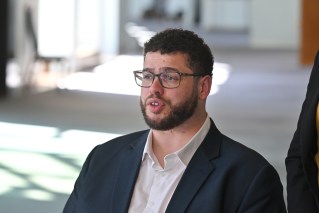
Dr Andre Oboler, CEO of the Online Hate Prevention Institute in Melbourne, said he was “quite shocked” to hear the announcement, having been among a large number of Jewish academic and civil society groups that had lobbied Facebook to make the change as far back as 2008.
“It’s certainly very welcome,” he told The New Daily.
“But people aren’t celebrating just yet. We’re waiting to see it delivered on, to make sure the change isn’t just words.”
‘Another step’ in hate crackdown
More than six million people were murdered in the Holocaust, the systematic killing of Jewish people by the Nazis through World War II.
Facebook cited a survey of people aged 18 to 39 in the United States, where one in four said they believed the Holocaust was a myth or exaggerated.
The company said the announcement “marks another step in our effort to fight hate on our services”, the latest crackdown on dangerous online activity after recently banning the QAnon conspiracy theory and anti-Semitic stereotypes.

Holocaust denial will be blocked from Facebook. Photo: Getty
Facebook said the platform has banned 250 white supremacist groups and removed about 22.5 million examples of hate speech in the second quarter of 2020 alone.
Under the change, people searching for Holocaust content on Facebook will be directed to “authoritative sources to get accurate information”.
Previous similar announcements have seen groups deleted, accounts banned, and posts removed.
But Facebook also warned the changes “cannot happen overnight”, saying “it will take some time to train our reviewers and systems”.
Facebook boss Mark Zuckerberg, who is Jewish, previously cited Holocaust denial as an example of speech he didn’t agree with but which shouldn’t be restricted.
“I don’t believe that our platform should take that down because I think there are things that different people get wrong. I don’t think that they’re intentionally getting it wrong,” he said in 2018.
However, on Tuesday, Mr Zuckerberg said his thinking had “evolved”.
“Drawing the right lines between what is and isn’t acceptable speech isn’t straightforward, but with the current state of the world, I believe this is the right balance,” he said in a Facebook post.
Facebook’s ‘U-turn’
Dr Oboler said he first asked Facebook more than a decade ago to take action on Holocaust denial.
He led a number of groups and reports into online anti-Semitism across the world since 2008, calling on Facebook to root out the issue, but had feared the company would never budge.
“They were responsive across a number of fronts, but this was always the exception, even as other things were improving. It was the line in the sand,” Dr Oboler said.

More than six million people were killed in the Holocaust. Photo: Getty
He said Holocaust denial was far more than just ignorance, instead “an organised effort to rehabilitate the idea of Nazism”. Dr Oboler sees Facebook’s eventual shift, 12 years on, as a sign of a wider shift in the company’s ethos.
“That’s the danger of Holocaust denial, and that’s what Facebook wasn’t getting,” he said.
“This, I think, was last remnant of an attitude Facebook took, that they were more important than society and governments. They’ve realised they’re a part of society, and need to fit within the expectations of society.”
Following action on the likes of QAnon, white supremacist organisations, and right-wing terror groups – spurred largely but not only by the Christchurch terror attack – Dr Oboler said the permittance of Holocaust denial was “the last thing that made no sense”.
“It was a remnant, and now it’s a sign they’ve completed that U-turn,” he said.
“Facebook, I think, is saying it’s not a space where anything goes and the greatest priority is freedom of speech. Instead, that it’s an online public sphere.”