Reserve Bank names Donald Trump main risk to global economy

US president Donald Trump’s imminent move to slap massive tariffs on Chinese exports has been singled out as the major threat to global economic stability by the Reserve Bank of Australia.
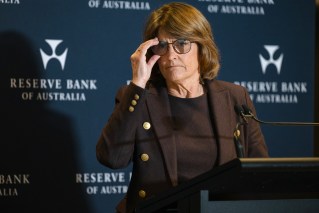
In his monetary policy speech on Tuesday, RBA Governor Philip Lowe warned the United States’ aggressive protectionism was creating global economic “uncertainty”.
It was the only global risk Mr Lowe mentioned explicitly.
A former RBA board member and economic adviser to former prime minister Paul Keating told The New Daily the RBA was right to be concerned, adding a trade war would have “dire” consequences for Australia and the world.
Mr Lowe’s warnings about US trade policy contrasted with his praise of the Chinese authorities, who he said were “paying increased attention to the risks in the financial sector and the sustainability of growth”.
He then turned to the US, saying: “One uncertainty regarding the global outlook stems from the direction of international trade policy in the United States”.
He was referring to Mr Trump’s unprecedented decision to impose, or threaten to impose, tariffs on many of the US’s most important trading partners, including China, Canada, Mexico and the European Union.
Sweeping tariffs on Chinese imports, worth $US34 billion ($A46 billion) a year, will come into force on Friday, slapping a 25 per cent charge on about 1000 different products.
The long list includes such obscure products as ‘haymaking machinery’, ‘vertical turret lathes’ and ‘printed circuit assemblies for automatic teller machines’.
Such tariffs violate World Trade Organisation rules.
China has already promised to retaliate immediately with similar tariffs on US agricultural imports.
The move has drawn near unanimous condemnation from the international community, as well as from large swathes of the US business community.
It has sparked fears that a global trade war could erupt, undermining the global economy, which is still recovering from the 2008 global financial crisis.
A recent piece in the Financial Times predicted the trade war could result in $US1 trillion worth of exports being subject to tariffs.
Effect on Australia
Professor John Edwards, an economist with Curtin University, a non-resident fellow of think tank the Lowy Institute and a former RBA board member, said the RBA was right to be worried.
He told The New Daily that, while Australia was not directly caught up in the trade war, it would not escape unscathed if a full-on trade war is unleashed.
In fact, he said such a “dire” eventuality would almost certainly result in a weaker dollar and lower economic growth.
“The US is still scheduled to impose tariffs on Friday, and China has undertaken to retaliate on Friday or Saturday,” he said.
“And Trump has said if China does retaliate, he might impose another $200 billion worth of tariffs.
“It’s conceivable – though it’s so dire it’s difficult to imagine – that the US is about to impose tariffs on its entire imports from China within a few weeks. It’s quite a serious situation.
“The RBA is quite right to be concerned. It’s a risk with a low probability but a high cost.”
Professor Edwards, who was an economic adviser to former prime minister Paul Keating in the 1990s, said the market would read this as a negative for Australia, meaning weaker growth in China, and so less demand for Australian iron ore, coal and other imports.
“I would expect the Aussie dollar to fall quite a lot. I can’t see a good outcome for Australia in this,” he said.

Capacity woes as data centres top mining boom

Rate rises and a recession we don't have to have

The surge in financial abuse against women