This might be why healthy young doctors and nurses are dying

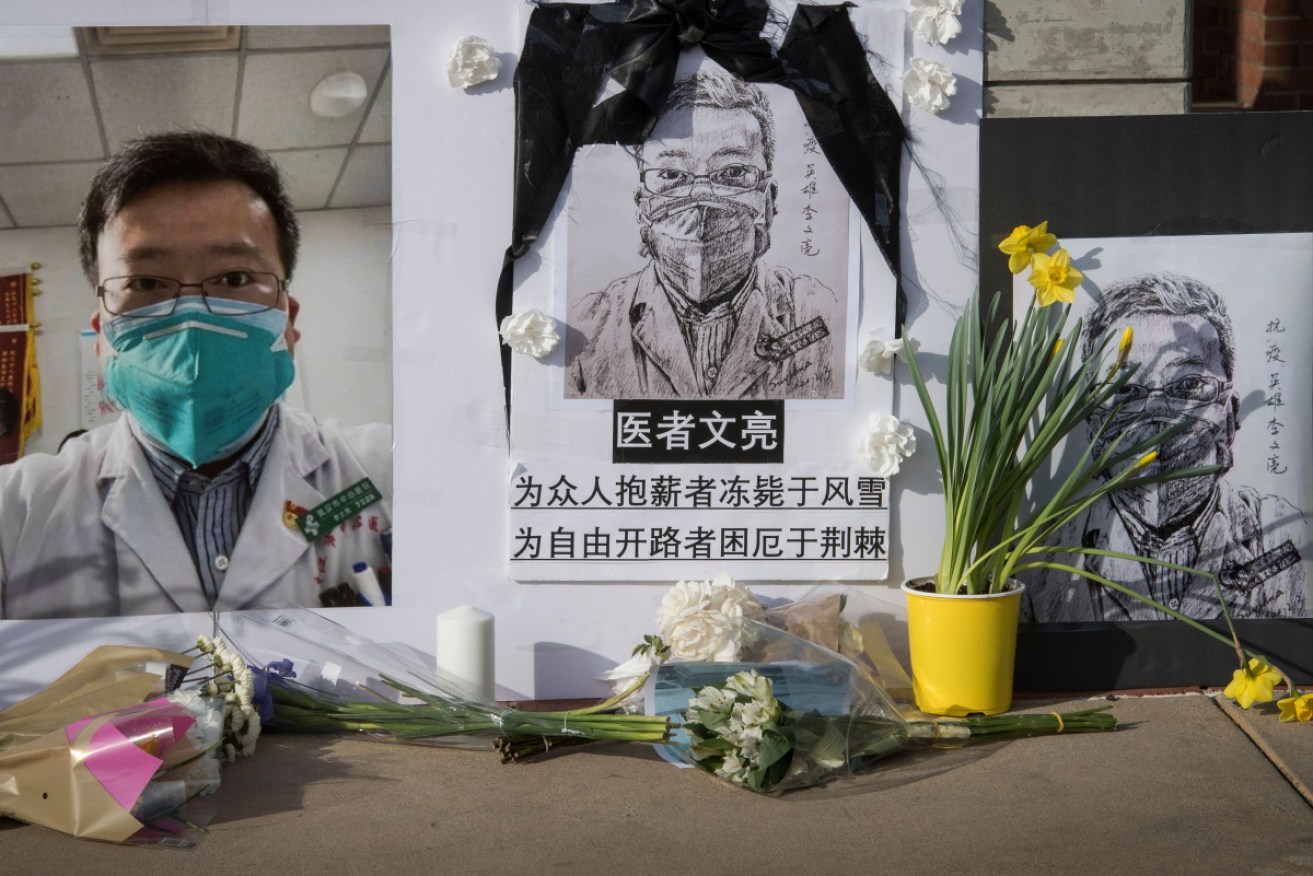
Chinese students and supporters hold a memorial for Dr Li Wenliang, the whistleblower of the coronavirus, COVID-19. Photo: Getty
Great crusades have their martyrs, people whose deaths become symbolic of a righteous struggle.
The first of these in the age of COVID-19 was Li Wenliang, the doctor in Wuhan who raised the flag on the coronavirus outbreak, only to be heavied by police.
Dr Li soon after died, at the age of 34, after weeks spent treating seriously ill patients.
That was back in February, when it seemed that young and healthy people were immune to the more devastating symptoms of COVID-19.
Since then, many more young doctors and nurses have died from the plague.
This became one more coronavirus mystery.
Does the virus hit healthcare workers harder?
Figures provided to The New Daily by Professor Carola G. Vinuesa,
Co-Director, Centre for Personalised Immunology, the Australian National University, show that by mid-March China had reported 3300 infected healthcare workers and 22 deaths, and in Italy, 20 per cent of frontline healthcare workers were infected.
Within two weeks of the first case being recorded in the Netherlands, six per cent of the healthcare workers were infected.
By then, CNN was reporting “the novel coronavirus seems to hit healthcare workers harder than others who contract the disease, but it’s unclear why”.
Dr Peter Hotez, professor and dean of the National School of Tropical Medicine at Baylor College of Medicine told CNN: “We know the high mortality in older people, but for reasons that we don’t understand, frontline healthcare workers are at great risk for serious illness despite their younger age.”
Could the virus be dose-specific like other poisons?
Further on, Dr Hotez hazarded a guess: “Maybe it’s due to a higher dose of virus they’re receiving. We don’t really know. It’ll take time to study.”
Since then, the idea that doctors get sicker because they literally inhale more of the virus has gained traction.
Last week, Joshua D. Rabinowitz, a professor of chemistry and genomics at Princeton, and Caroline R. Bartman, a Princeton research fellow, co-authored a piece in The New York Times.
“Is it possible that Dr Li died because as a doctor who spent a lot of time around severely ill COVID-19 patients, he was infected with such a high dose?” they write.
“After all, though he was one of the first young healthcare workers to die after being exposed up close and frequently to the virus, he was unfortunately not the last.
“The importance of viral dose is being overlooked in discussions of the coronavirus.
“As with any other poison, viruses are usually more dangerous in larger amounts. Small initial exposures tend to lead to mild or asymptomatic infections, while larger doses can be lethal.”
Not all viruses are the same
This week, Dr Sarah Caddy, Clinical Research Fellow in Viral Immunology and Veterinary Surgeon, University of Cambridge, wrote in a piece at The Conversation it’s known that for some diseases “the dose of virus a person is exposed to will directly correlate with how severe the disease is”.

Within two weeks of the first confirmed COVID-19 infection in the Netherlands, six per cent of healthcare workers were infected. Photo: Getty
A good example, she writes, is influenza.
“A 2015 study from the US showed that the higher the dose of influenza virus given to healthy volunteers, the worse their symptoms,” Dr Caddy said.
But not all viruses are the same, and in some instances “a single infected cell can produce hundreds, if not thousands, of copies of the particle. This means that for some viruses, even a tiny dose of virus is enough to cause an infection”.
Complicating factors
Dr Caddy said viral dose might be only one factor affecting the severity of illness.
“How the body responds to the virus can also be critical,” she writes.
“This is because the immune response to a virus can be both beneficial and harmful.
“If the immune system isn’t adequately activated, the virus can replicate faster.
“On the other hand, if the immune system is over-activated, it can damage healthy tissues.”
And aside from the “long list of medical conditions that can increase the chances of having a severe case of COVID-19”, there’s exhaustion and extreme stress to consider, especially in healthcare workers who are working long, hard hours.
“We expect many frontline medical staff to be under significant pressure in the coming weeks and months; could this affect their susceptibility?” she writes.
Professor Vinuesa told The New Daily the virus-dose theory “makes sense scientifically” but it needed to be proven in a controlled study.
“It’s been out forward as a plausible explanation, but it would need a proper study to be confirmed.”
In an email, Professor Vineusa, said: “Infection in healthcare workers have consequences that exacerbate the management of the epidemic, since they risk propagating infection amongst patients which are susceptible to COVID-19 complications, and they take healthcare workers out of the essential workforce.
“We thus strongly propose that all healthcare workers with direct patient contact should be offered testing (both SARS-CoV-2 nucleic acid testing and serology).”
Want to see more stories from The New Daily in your Google search results?
- Click here to set The New Daily as a preferred source.
- Tick the box next to "The New Daily". That's it.