Tiny ocean heroes secure own research hub
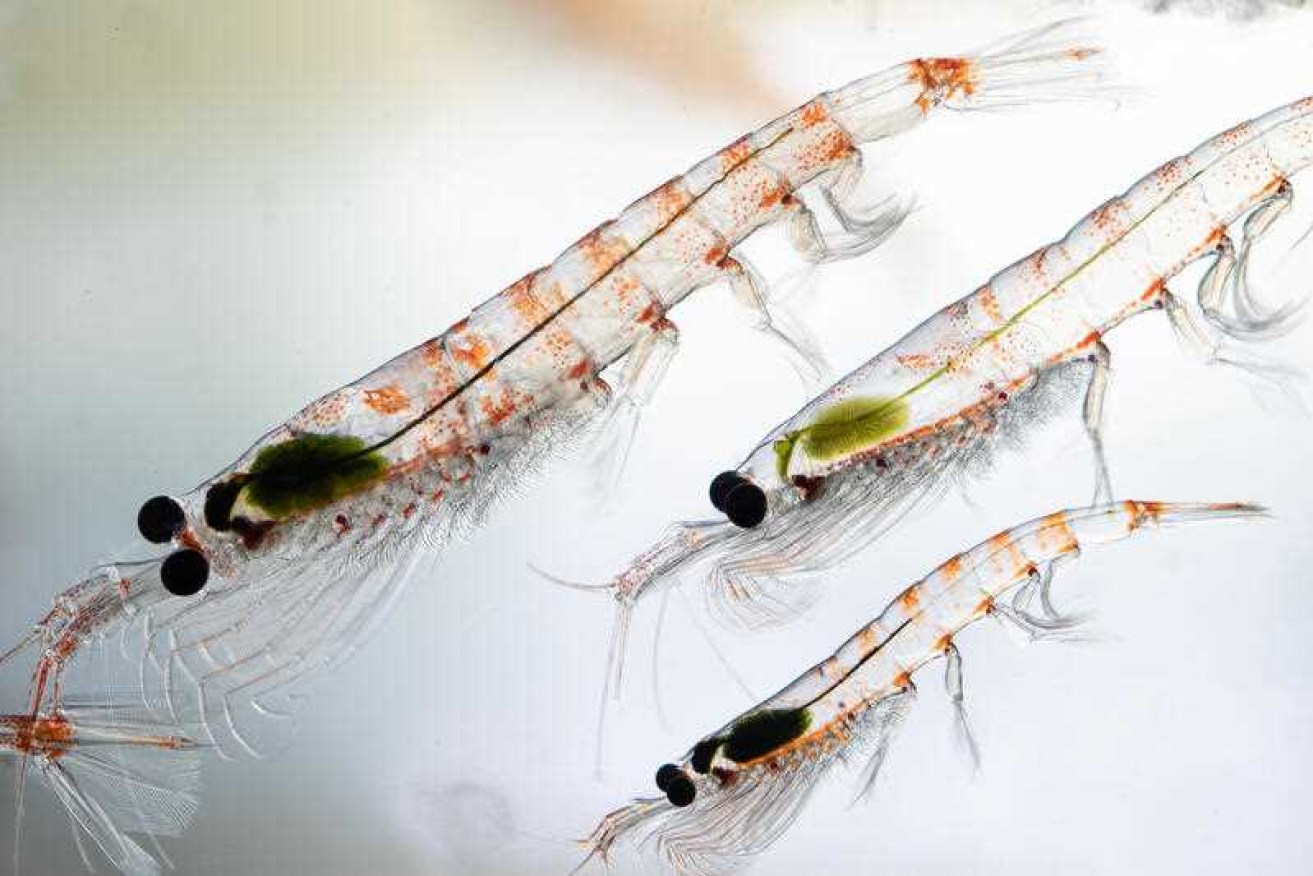
A research facility will be built in Hobart to probe how Antarctic krill respond to climate change. Photo: Supplied
In the charismatic creature stakes, krill don’t typically rate a mention let alone elicit the kind of wondrous gasps reserved for the planet’s largest animal.
Yet the small, unsung heroes of the Southern Ocean are the very things that sustain the mighty blue whale.
And Antarctica’s charming fur seals.
And the icy continent’s majestic Emperor penguins.

Emperor penguins and their young are sustained by krill. Photo: Getty
In fact, krill underpin the entire Antarctic food web and it’s hard to overstate how crucial they are, says Australian Antarctic Division marine biologist Rob King.
“We just wouldn’t have the ecosystem we have down there without them.”
All that explains why the federal government is dropping $25 million on a new, world-leading aquarium in Hobart, to research how the most abundant wild animal species on earth is responding as the ocean warms and acidifies.
“Understanding how that will affect krill and the other species in the ecosystem is absolutely critical,” Mr King says.
“To do that you need to have laboratories where you can control the properties of sea water very accurately.
“Every scientist wants to do research in the wild, where the animal lives, but that’s very difficult for Antarctic krill.”
The next best thing is to harvest wild krill and bring them back for study under highly controlled conditions in a purpose-built aquarium.
It will be the crowning glory in a newly redesigned supply-and-capture system.

Wild krill will be harvested and brought back for study under highly controlled conditions in a purpose-built aquarium. Photo: Getty
Australia’s new Antarctic icebreaker, RSV Nuyina, has a wet well facility, a safe way to capture krill without using trawl nets, which have a high mortality.
Instead of 10 per cent of a harvest surviving for study, it’s now more like 95 per cent.
Mr King, who built the facility the new aquarium will replace, says it’s a monumental step forward in support of a species that is already a climate change ally.
Krill eat phytoplankton – microscopic plant-like organisms that live in the ocean and consume carbon dioxide on a scale equivalent to forests on land.
“The bits they don’t eat come out as krill poo and rapidly sink taking that carbon into the deep ocean. That’s called the biological pump,” Mr King says.
“Lots of animals do this. But the reason krill matter so much is because there’s so many of them. It really has a significant effect.
“If that carbon is not in the surface ocean, more can dissolve in from the atmosphere. The less we’ve got in the atmosphere, the less global warming we get.”
Essentially the process is buying humanity time to get a handle on carbon emissions.
“Once it’s down in the deep ocean the carbon may be locked up for 1000 years before it comes back. That gives us an awful lot more time to sort out solutions.”
The new aquarium, to be run by the Australian Antarctic Division, will also be open to other researchers. Construction at Taroona is due to begin next year.
-AAP
‘Super pest’ detected in Sydney warehouse
Magnitude 4.8 quake shakes Victoria