Alarming One Nation numbers are an early warning signal, not a crystal ball

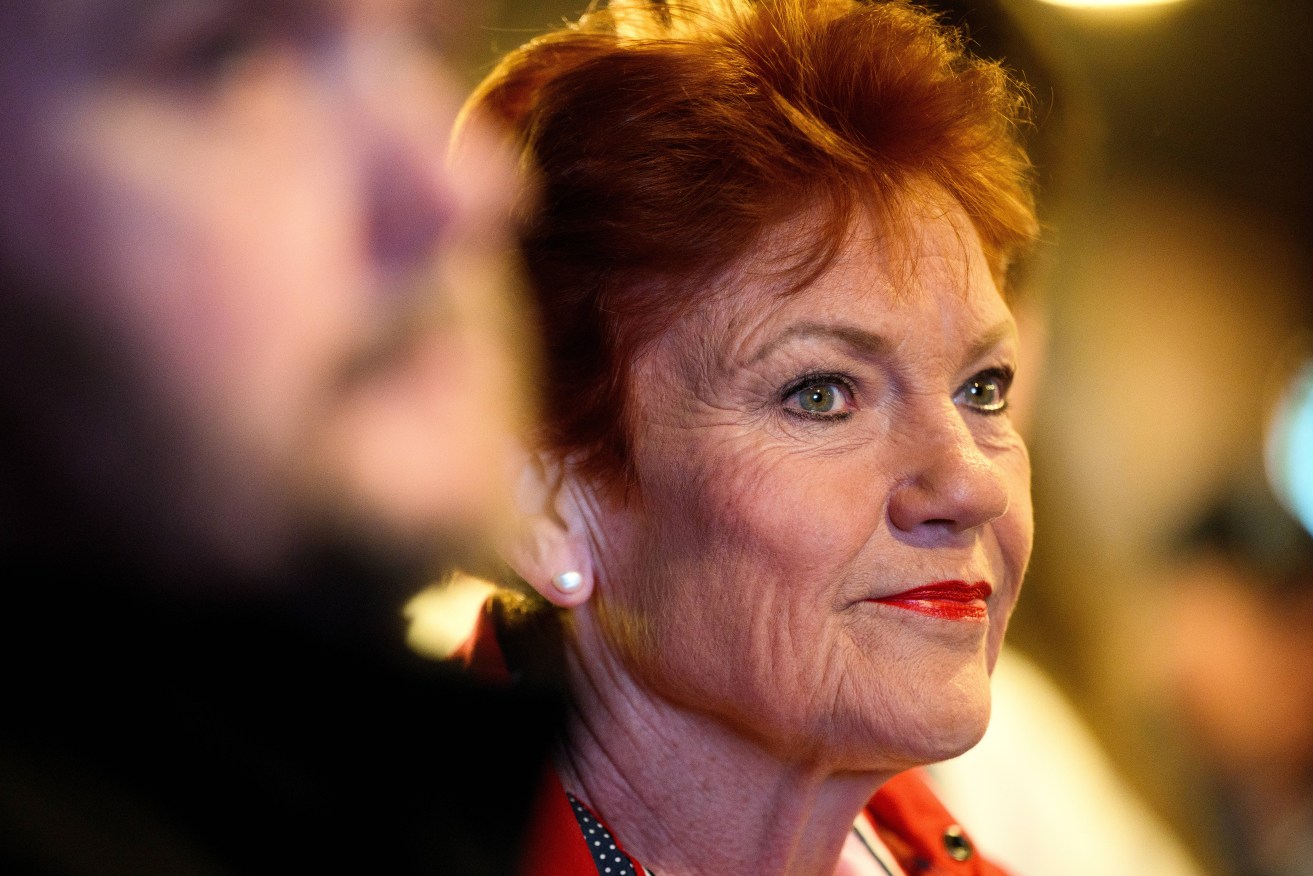
Bracing for a historic win: One Nation Leader Pauline Hanson. Photo: AAP
Polling points to a rapidly fragmenting electorate, with One Nation attracting unprecedented support and the major parties facing growing voter dissatisfaction. Ignoring the trend is no longer an option.
Commentary from both left and right has sought to dismiss the implications of the Red Bridge/Accent MRP opinion survey published by the Australian Financial Review last week under the heading Is this our political future?
The myopic yet visceral rejection of the threat posed by the resurgence of One Nation over the last six months is foolhardy.
MRP is the short hand label for Multilevel Regression with Post-stratification.
Poll after poll has identified that one in four voters are seriously considering voting for One Nation, and that the LNP has fallen behind One Nation and is coming in third.
For Labor, however complacency is not warranted, even if the projected two-party preferred vote has remained solid.
The Red Bridge/Accent survey conducted in the first half of May 2026 finds that if an election was held now, 62 of the 150 House of Representatives seats would change hands.
A range of predictions as to the number of seats that would swing between parties is proffered. Median predictions are that Labor would have 76 seats, One Nation 53, and the Coalition 12, and there would be 9 others.
In this scenario the Coalition are at risk of losing 37 seats to One Nation, and Labor 16. It is proposed that at the moment the Coalition is at risk of not holding any seats in Queensland, Western Australia, South Australia or Tasmania.
It is important to point out such a prognosis is not static, that preferences will have a decisive impact and that small shifts in the primary vote will significantly change a number of seats, however such a proposition does not disrupt the pattern that has been identified.
The results presented are described by Redbridge “as a problematic snapshot of current opinion”.
So is the fragmented electorate thesis that underpins the Red Bridge/Access research accurate? Or does Red Bridge mistake electoral volatility for fragmentation? This is where judgement becomes important.
MRP methodology is standard internationally and is recognised as an effective compensation for traditional polling deficiencies, particularly at the outer suburban and regional level.
The MRP methodology aggregates demographic characteristics with consensus data; more accurately identifying attitudinal shifts away from traditional voting habits. It helps explain why Labor’s primary vote can fall dramatically but its 2PP votes remains sufficient to retain government.
The MRP survey acts as an early warning system rather than as a crystal ball, but it serves as a useful diagnostic tool.
Traditional polling lumps all Australians across the country together as a broad stratum. Sample weighting relies on judgements to counter low response rates. MPR gives insights into differences in attitudes based on age, gender, education, religion, class.
This information can be set against census results. The sample sizes of 6,000 votes are arguably more accurate than the small state-by-state samples. Like all polling, judgement is required in the modelling assumptions and the interpretation of results.
MPR is strongest in identifying structural patterns of voting attitudes of distinct economic, geographic and cultural blocks.
The failed by-products of neo-liberalism are now reflected in our politics.
Traditional conservatives will argue that the Red Bridge fragmentation thesis over-emphasises inequality and social class in explaining voter disillusionment and establishment hostility.
Smart conservatives like Andrew Hastie have declared that “No-one’s going to reward us for a final last stand for neo-liberal politics.” “And there is no medal for blindly defending outdated neo-liberal economic frameworks.”
What is clear is that economic insecurity, falling living standards, unequal distribution of asset wealth, the housing crisis, precarious employment, and the decline in manufacturing jobs, have driven political grievance in the outer suburbs and regional areas.
This reinforces a lack of confidence and trust in government, non-government organisations and legacy media.
The impact of 16 interest rate rises since the end of the pandemic cannot be overlooked when examining the political malaise facing the country. Small interest rate falls are quickly forgotten.
The fragmented electorate thesis is persuasive, but is it reversible? That depends on the political system’s responses that recognise that old electoral coalitions are breaking down rapidly.
The Coalition’s dilemma is particularly acute because sections of its traditional base are no longer merely dissatisfied with policy outcomes; they are increasingly alienated from the institutional and economic order that the Coalition historically defended.
Attempts to compete rhetorically with right-wing populism may slow electoral leakage, but it will not resolve the deeper fracture within conservative politics.
For Labor, electoral survival cannot rely indefinitely on preference flows and opposition fragmentation. A strategy of cautious incrementalism may preserve office in the short term, but it is unlikely to rebuild durable political loyalty in communities experiencing declining living standards and diminishing economic security.
Rebuilding a democratic economy capable of restoring confidence in government’s capacity to provide security, opportunity and dignity is now essential.
The warning contained in the RedBridge/Accent polling is not that One Nation is destined to govern, nor that current seat projections will materialise unchanged.
It is that the political foundations of the two-party system are eroding more rapidly than many in Canberra appear willing to acknowledge.
Unless governments can restore confidence that democratic institutions are capable of delivering economic security, fairness and national purpose, fragmentation will deepen and populist movements will continue to grow.
Ignoring that trend will be at our peril.
Kim Carr is a former Labor senator and minister, and is currently Vice-Chancellor’s Professorial Fellow at Monash University
This article first appeared in Pearls and Irritations. Read the original here
Want to see more stories from The New Daily in your Google search results?
- Click here to set The New Daily as a preferred source.
- Tick the box next to "The New Daily". That's it.


Nonnamaxxing: Fantasy of inherited nostalgia




Only one reason a Liberal-Hanson deal makes sense