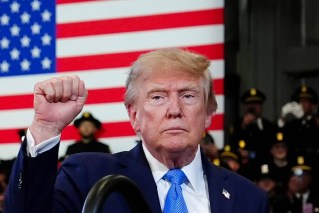
President-elect Donald Trump told to accept Russia hacked election
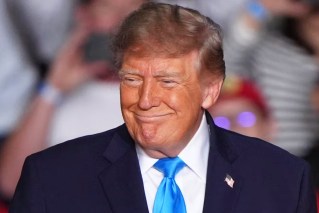
Donald Trump has dismissed claims of Russian interference in the United States election as “ridiculous” despite a push by senior Republican Party colleagues for a probe into the explosive allegations.
Mr Trump’s claims came as Hillary Clinton’s campaign pushed for a wider investigation into the reported interference, and even the White House alleged Mr Trump clearly benefited from hacks on Democratic National Committee and Clinton campaign emails during the US presidential election.
Numerous US media outlets have verified claims (first aired Friday AEDT) by anonymous CIA insiders alleging that the Russian government directed hackers to leak emails damaging Democratic Party candidate Hillary Clinton.
These verifications came as a group of Mr Trump’s senior Republican Party colleagues – including influential foreign policy voice, Senator John McCain – pledged to hold investigations into the suspected hacking.
Senator McCain urged the president-elect to accept that Russia did interfere in November’s election, telling CBS that “the facts are there”.
On Sunday, Senator McCain and Republican Lindsey Graham joined two Democrat senators in releasing a statement expressing concern over the CIA’s claims.
“For years, foreign adversaries have directed cyberattacks at America’s physical, economic, and military infrastructure, while stealing our intellectual property,” the bi-partisan statement, co-released with Democratic rivals Senator Charles Schumer and Senator Jack Reed, read.
“Now our democratic institutions have been targeted. Recent reports of Russian interference in our election should alarm every American.
“We have an obligation to inform the public about recent cyberattacks that have cut to the heart of our free society. Democrats and Republicans must work together.”
Meanwhile, the Clinton campaign on Monday (US time) said the Obama administration “owes it to the American people” to reveal what it knows about Russian interference in last month’s election.
Campaign chairman John Podesta, whose emails were stolen and posted on the internet, said: “Never before in the history of our Republic have we seen such an effort to undermine the bedrock of our democracy.”
Mr Podesta said the campaign supported an effort by a handful of members of the Electoral College, including a Republican who said he would not vote for Mr Trump, to be briefed on US intelligence on potential links between Mr Trump’s campaign and Russia.
On Monday, White House Press Secretary Josh Earnest told a press briefing that Mr Trump clearly benefited from hacks on Democratic National Committee and Clinton campaign emails.
“You didn’t need a security clearance to figure out who benefited from malicious Russian cyberactivity,” Mr Earnest said.
“The president-elect didn’t call it into question. He called on Russia to hack his opponent. He called on Russia to hack Secretary Clinton. So he certainly had a pretty good sense of whose side this activity was coming down on. The last several weeks of the election were focused on a discussion of emails that had been hacked and leaked by the Russians. These were emails from the DNC and John Podesta, not from the RNC and Stephen Bannon.”
Republicans McCain, Senate Majority Leader Mitch McConnell and Senate Foreign Relations Committee Chairman Bob Corker were in the process of forming an inquiry into the allegations, the Washington Post reported.
The unusual calls from both sides of US politics follow the push by a group of Democrat senators for President Barack Obama to release classified information they believe contains evidence of Russian interference in the US election.
Despite these public statements, Mr Trump has dismissed the claims and continues to maintain a sympathetic attitude towards Russia and its controversial leader President Vladimir Putin.
In October, a joint statement from US intelligence agencies claimed they had detected evidence of Russian hackers “scanning” the servers of state electoral administrators in the months leading up to the November poll.
“Some states have also recently seen scanning and probing of their election-related systems, which in most cases originated from servers operated by a Russian company,” they said in the October release.
Swinburne University political scientist Bryan Cranston, who is a US politics analyst, told The New Daily the CIA’s revelations and constant calls for an inquiry were “damaging” for Mr Trump.
“We long suspected there would be issues for his presidency, but many thought it might wait until he took office,” Mr Cranston said. “Maybe the history books were written too soon by judging Russia as losing the Cold War, maybe this is Russia coming back to try and win it.”
Allegations a Democrat ‘excuse’: Trump
Mr Trump told Fox News on Monday any suggestions Russia influenced his election win were “ridiculous“.
“I think it’s ridiculous. I think it’s just another excuse. I don’t believe it,” the property mogul said, accusing the Democratic Party and not the CIA of spreading the allegations.
The Democratic Party emails, which were allegedly delivered to Wikileaks by Russian hackers, were released during Mrs Clinton’s long presidential campaign.
They became a key aspect of Mr Trump’s attacks on her, and included revelations that the Democratic Party may have favoured Mrs Clinton over Bernie Sanders in the Democratic primary race, as well as details of her speeches to big banks.
On the emails being leaked by Russia, Mr Cranston said: “It is almost certain that there was some international involvement in the election. All the public evidence suggests this.”
“It is very ironic that a cornerstone of Mr Trump’s campaign was saying that the only way he could lose was if the election was rigged for Mrs Clinton,” he said.
Mr Trump shocked the world, and almost every pollster, by defeating Mrs Clinton in the November 8 election.
Despite Mrs Clinton sitting more than two million votes ahead in the popular vote, Mr Trump dominated in key marginal states to win the election, which is decided using the Electoral College vote system.
– with ABC